 Looking for a fun thing to do with your family?
How about tracking the International Space Station as it streaks across the sky?
It’s easy, it’s fun, and it’s pretty amazing to think that there really are people up there!
NASA has provided us with a wonderful website to let us know when the Space Station will be visible to us, wherever we live. Open the Human Space Flight link in a new window or tab and I’ll step you through the process.
The page might take a few seconds to load, and you need to have JAVA enabled. The first screen you’ll see is this one:
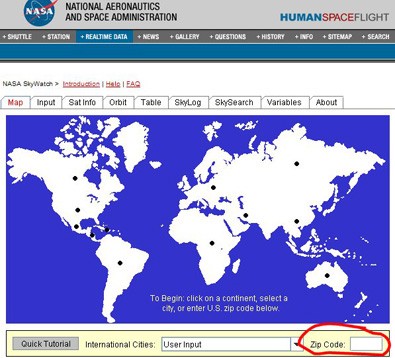
Enter your zip code in the lower right hand corner (I circled it for you) and hit “enter.” That will take you to this screen:
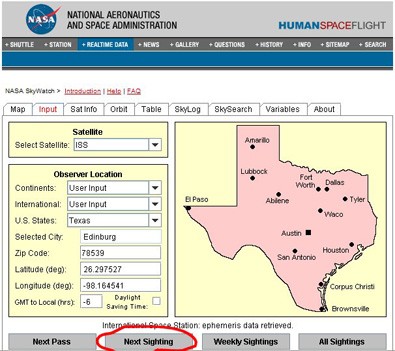
On this page, you should see your hometown (or viewing site), your zip code, your town’s latitude and longitude and your time zone difference from Greenwich Mean Time (GMT). Click on “Next Sighting.” The computer will begin searching for the next opportunity you’ll have to see the International Space Station (ISS). If nothing comes up on the first search, click on “Next Sighting” again and it’ll continue the search. Eventually, you’ll see a screen like this one:

I’ve circled the time and date of my next sighting. The time gets a little bit more specific in the table on the page saying the ISS will come into view at 6:15:57AM and stay in view until 6:18:37AM. So, if I get up early on January 21st, I’ll be able to see the ISS for about 2 1/2 minutes.
Where Do I Look?
The NASA page tells you exactly where to gaze, but you need a little background. The first thing to understand is Azimuth:
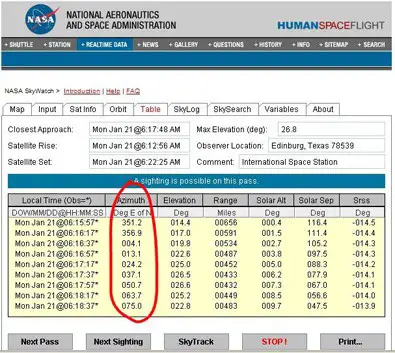
It says “Degrees E of N” or East of North. Look at the compass below.
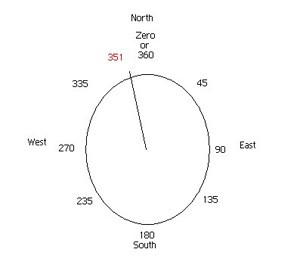
Think of North as 0 Degrees. East is 90 degrees, South is 180 degrees, West is 270 degrees…and if you go all the way around, you come back to 0 or a full 360 degree circle.
My “next sighting” page indicates the ISS will appear at 6:15:57AM at azimuth 351.2. That means almost just a little bit West of straight North as the compass indicates. I will last be able to see the ISS at 6:18:37 AM at azimuth 75.0. So…looking at the compass and interpolating a little bit, the ISS will end up in the eastern sky. So, we now know the shuttle will appear in the north and head eastward. If you go outside and look to the north, the shuttle will appear right in front of you and move to the right. It’ll take about 2 1/2 minutes to make the trek across the sky.
How High Will It Be?
This takes us to our next part of the equation. Look at the “Elevation” column – which is given in “degrees” above the horizon.
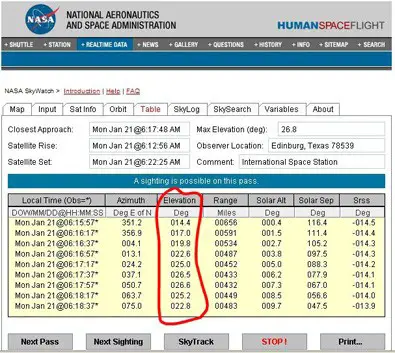
This tells us how high in the sky to look. If you gaze straight at the horizon – that’s Zero degrees. If you look straight up – that’s 90 degrees.
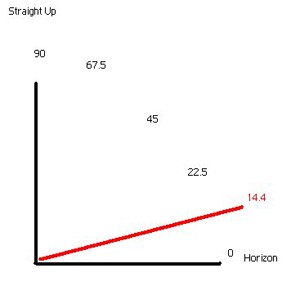
My sighting chart tells me the ISS will appear 14.4 degrees above the horizon. That’s pretty low in the sky. By the end of my viewing window, the ISS will be at 22.8 degrees…still rather low in the sky.
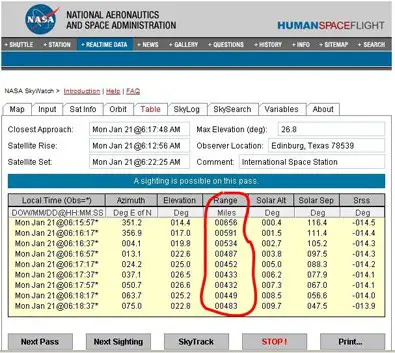
The last thing I’ll guide you through is “Range.”
That tells you simply how far the ISS is from you at that moment – in miles.
There are many other options to explore on the Human Space Flight page. Browse and have fun. It’s a great learning activity for the kids and a fun family activity. Remember, the sky needs to be clear to see the International Space Station. If you can’t see the stars, you won’t be able to see the ISS. Happy Gazing!